




If 2024 was the year of the “Healing Romance,” 2025 has violently corrected course to become the year of Female Rage—with Dear X leading the charge. We have seen a surge of narratives centered on complex women, anger, and survival—from the calculated vengeance of The Glory to the chaotic spiraling of Queen Mantis. But amidst this wave of “Good for Her” content arrives a drama that walks into the room, kicks the door open with an insane amount of flair, and then proceeds to gaslight its audience for twelve straight hours.
Based on the popular webtoon, Dear X promised to be a deconstruction of the perfect victim trope. It offered us Baek Ah-jin, a protagonist who wasn’t just misunderstood or morally grey, but clinically, unapologetically sociopathic. It was a bold pitch: What if the main character is the villain of her own story?
The result is a drama that starts as a masterpiece of tension—a Gone Girl for the K-Drama world—and ends as a chaotic, illogical disaster that betrays its own premise. It is a show that demands you empathize with a monster, only to laugh in your face for expecting a logical conclusion. But despite its narrative failures, it features a career-defining performance from Kim Yoo-jung, making it the most frustrating “must-watch” of the year.
Synopsis: The Art of the Long Con
The story begins with a visual that is pure cinema: a young girl standing in the rain, looking down at her dying mother not with horror, but with calculation. This is Baek Ah-jin (Kim Yoo-jung). Growing up in a hellish environment with an abusive mother and a complacent, cowardly father, Ah-jin learns a terrifying lesson early on: emotions are liabilities, and people are tools.
The drama tracks her rise from a traumatized child to the nation’s most beloved actress—a journey paved literally with the broken bodies of those who loved her. She is a woman who wears a mask of angelic innocence to hide a soul that has been hollowed out by abuse. Her goal is simple: survival at the highest possible altitude.
She is aided by Yoon Jun-seo (Kim Young-dae), her stepbrother and reluctant enabler, and Kim Jae-oh (Kim Do-hoon), a childhood friend whose loyalty borders on tragic stupidity. What begins as a survival story morphs into a cycle of destruction when a documentary director threatens to expose her true nature. Ah-jin initiates a final, destructive game to protect her throne, ruthlessly manipulating everyone—from her rivals to her lovers—to ensure she remains the last one standing.
Themes: Beyond Good and Evil
1. ASPD as a Cheap Prop
The show introduces Ah-jin as someone with Antisocial Personality Disorder (ASPD), but it uses this diagnosis as a cheap plot device rather than a subject of genuine psychological exploration. It frames her condition as purely monstrous and evil, doing a massive disservice to the complexity of mental health. Rather than delving into how her trauma made it difficult for her to connect, the writers use her diagnosis to justify cartoonish villainy in the second half. It posits that people with ASPD are incapable of humanity, which simplifies a complex condition into a horror movie trope.
2. Destructive Devotion
The male leads in this drama represent a specific brand of toxic loyalty. They aren’t romantic heroes; they are enablers.
- Jun-seo sees Ah-jin’s madness but chooses to be blind, mistaking his desire to control her for love. His devotion is actually a form of arrogance—he believes he is the only one who can fix or save her.
- Jae-oh represents the tragedy of unconditional love given to someone who cannot return it. He is the only character whose kindness feels unmanufactured, which makes his fate all the more cruel.
3. The Illusion of Accountability
Perhaps the most frustrating aspect of Dear X is its refusal to create a world where accountability exists. Ah-jin causes endless suffering—she destroys careers, manipulates suicides, and ruins families—yet the narrative refuses to let her truly pay the price. The universe of the drama feels oddly weightless; consequences are things that happen to other people, never to Ah-jin. This lack of narrative justice leaves the viewer feeling less like they watched a tragedy and more like they were complicit in a crime.

Character Analysis: A Study in Wasted Potential
Baek Ah-jin (Kim Yoo-jung)
Kim Yoo-jung is mesmerizing. She sheds her “Nation’s Little Sister” image to play a character who smiles with her mouth but never her eyes. She captures the dead-eyed stare of a sociopath perfectly, shifting between vulnerability and menace in a way that is terrifyingly efficient.
- The Critique: However, the writing fails her. Ah-jin is written as an empowered queen when in reality she is a destructive force who bites the hands that feed her. By the final episodes, she stops using her brain entirely, making sloppy mistakes that betray the genius manipulator persona established in the first half.
Yoon Jun-seo (Kim Young-dae)
Kim Young-dae finally found a role that suits his stoic acting style. He is too pretty to be this expressionless, but his blankness works here as a man who has numbed himself to survive his sister’s chaos.
- The Critique: His character arc is the most frustrating. He always assumes the worst of Ah-jin yet refuses to leave her. He is a hypocrite who claims to have morals but helps cover up crimes. His decision in the finale to die together felt less like Romeo and Juliet and more like a cheap, melodramatic exit for a character the writers didn’t know how to resolve.
Kim Jae-oh (Kim Do-hoon)
The heart of the show. Jae-oh is the only character who loved Ah-jin for who she was, not who he wanted her to be.
- The Critique: He is the show’s most tragic casualty. Ah-jin manipulated him relentlessly, chaining him emotionally for years, only for him to die a meaningless death to save her from a contract she signed willingly. His death felt like shock value rather than a earned narrative beat.
Moon Do-hyuk (The Husband)
Introduced late as a major antagonist, the husband character felt like a waste of screen time. He was a one-dimensional psycho inserted to give Ah-jin a bigger bad to fight, but his arc added nothing to our understanding of her journey. He was a plot device with a pulse, and his lack of consequences in the finale was baffling.
Key Quotes & Dialogue
The dialogue in Dear X is often sharp, cynical, and revealing of the characters’ twisted worldviews.
- Episode 1: “I am not a monster. I am just… adapted.” – Baek Ah-jin (Summarizing her survivalist philosophy).
- Episode 3: “People are easy. You just have to show them exactly what they want to see.” – Baek Ah-jin.
- Episode 8: “I will climb so high that no one can ever look down on me again.” – Baek Ah-jin (Her core motivation).
- Episode 11: “You made me this way. Consider this payback for destroying my childhood.” – Baek Ah-jin (To her father).
- Episode 12: “Let’s go to hell together.” – Yoon Jun-seo (The fatalistic proposal).
Cinematography and Visuals
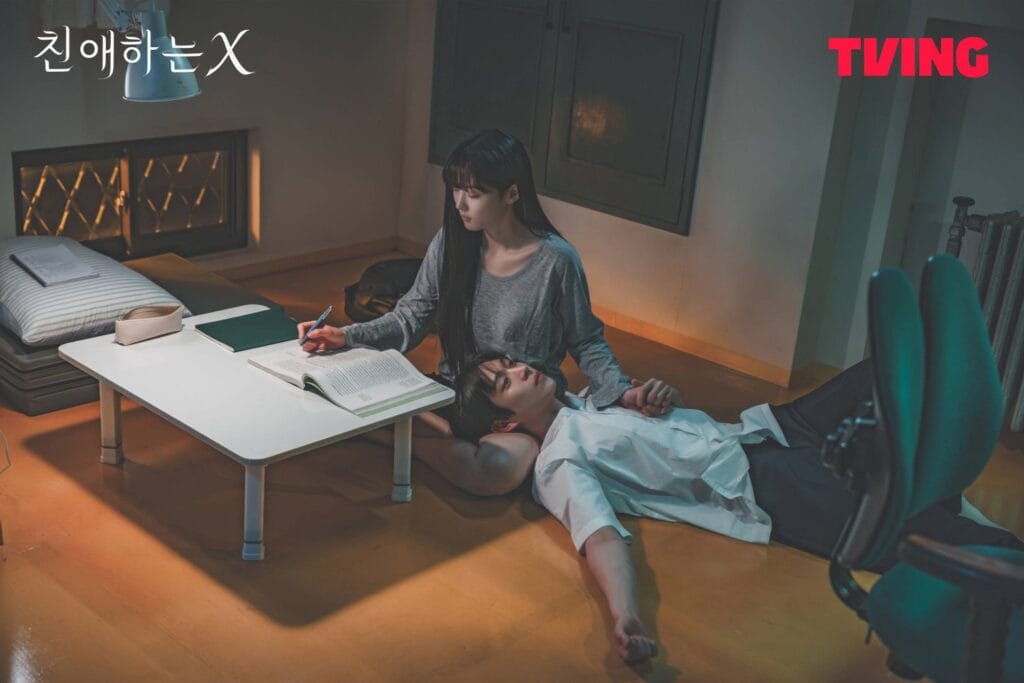
If the script is a mess, the visuals are a masterpiece. The drama is undeniably “aesthetic.” It is obsessed with looking meaningful—moody lighting, dramatic hallways, expensive wardrobes—even when the script lacks depth.
- The “Fluorescent Artifice”: Director Lee Eung-bok uses bright, over-saturated lighting in Ah-jin’s public scenes to highlight the fakeness of her celebrity life.
- The “Suffocating Dark”: In contrast, her private moments are shot in low light, often emphasizing her isolation. The first episode, specifically the scene of young Ah-jin in the rain over her mother, was cinematic perfection, setting a bar the rest of the show struggled to reach.
The “Deep Dive”: A Special Episode (Episode 8)
Title: The Death of Innocence 🛁🥀
While the finale is explosive, Episode 8 is the narrative pivot point where the show transitions from a tragedy to a horror story. It is the moment the audience realizes Ah-jin is past the point of redemption.
1. The Bathtub Hallucination 🛁
The visual highlight of the series is the “Bathtub Scene.” After a crushing loss, Ah-jin sits in a bathtub, fully dissociating from her pain. She hallucinates a conversation with her dead lover, In-gang. The lighting shifts to a bruised, underwater blue, and Kim Yoo-jung’s acting here is terrifyingly vacant. It is the moment she chooses to become a monster rather than feel the grief of a human.
2. The Grandmother’s Fall 👵
The episode’s climax involves the death of the Grandmother—the only adult who ever showed Ah-jin unconditional love. The ambiguity of this scene sparked massive debate: Did Ah-jin push her? Or did she simply fail to save her? The show leaves it purposefully vague, but the result is the same: with the Grandmother gone, Ah-jin’s last tether to humanity is severed.
3. The Prayer 🙏
In a rare display of vulnerability, Ah-jin is seen praying desperately at the hospital. This scene is pivotal because it reveals she wanted to be good, but believes the universe will not let her. It reframes her subsequent villainy not as joy, but as a revenge against a god that ignored her prayers.

Impact and Reception: The Webtoon vs. Drama Debate
Dear X polarized audiences in the best way possible.
- The Acting: Critics and fans alike praised Kim Yoo-jung’s “explosive” acting, noting that she successfully transitioned into a mature, villainous role.
- The Controversy: However, the twisted ending sparked heated debate. Webtoon readers were furious. In the original comic, Ah-jin faces genuine karma—she loses everything and is left pathetic and alone. The drama, however, gives her a strange “survival” ending where she walks away with a new face and a new life.
- The Consensus: Many felt the drama “softened” the blow, refusing to punish its star in a way that felt satisfying. It turned a cautionary tale about sociopathy into a weird survival fantasy for a villain.
Dear X Conclusion: A Beautiful, Frustrating Mess
This drama is an addictive hot mess. It starts with a bang and ends with a whimper. It is a show that demands you empathize with a monster, only to laugh in your face for expecting a logical conclusion.
The ending is narratively hollow: the good characters (Jae-oh, Jun-seo) die meaningless deaths, while the monster (Ah-jin) walks away with nothing but a bruised ego and a new life. It sends a baffling message: if you are selfish enough, you will survive.
The Verdict:
- Watch it for: Kim Yoo-jung’s masterclass in acting. She is terrifying, beautiful, and the only reason this show works.
- Skip it if: You need logical endings or justice.
- Final Score: Watch the first 8 episodes, then pretend it got cancelled,
unless you enjoy screaming at your screen. Your choice.





Leave a Comment