


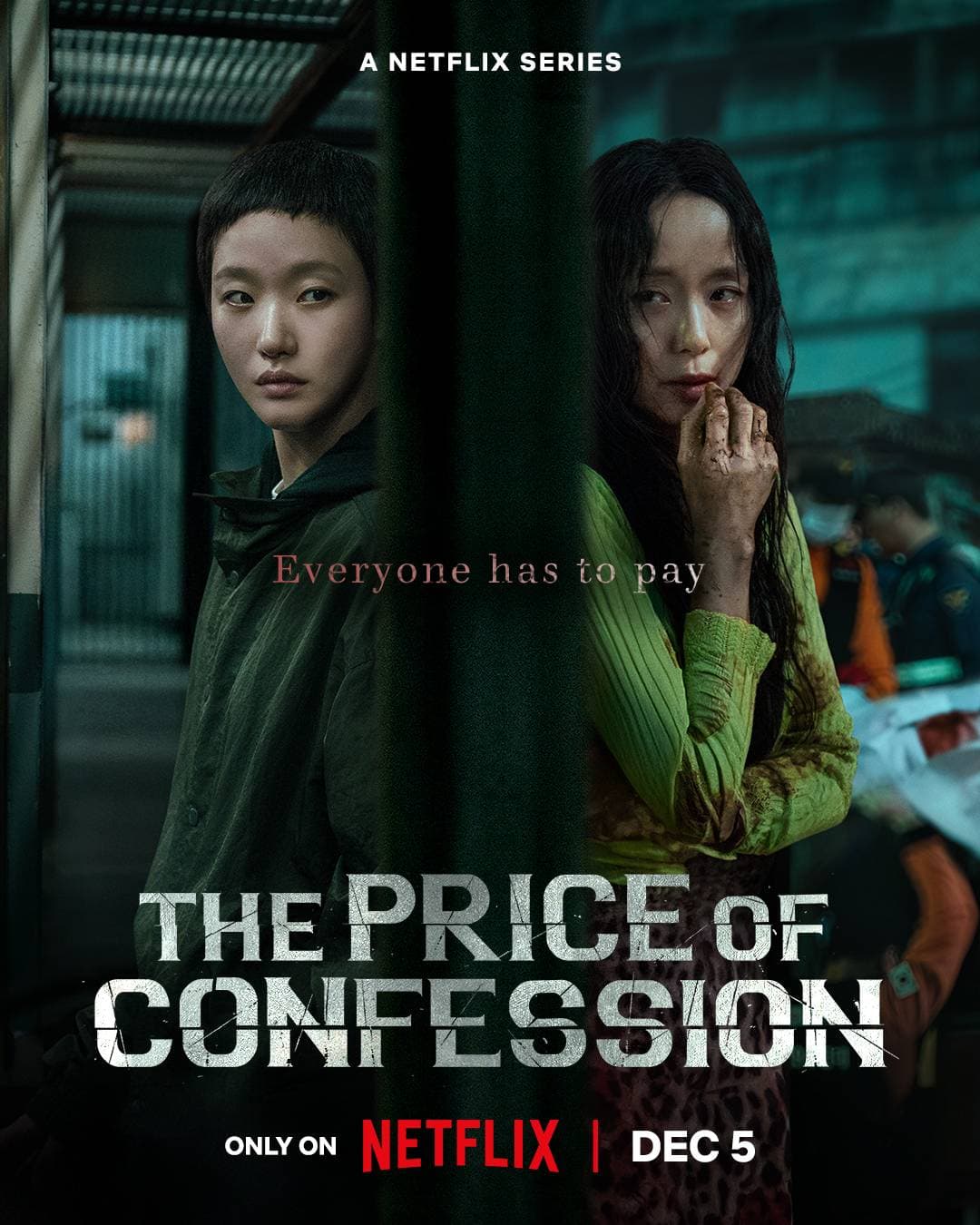

In the landscape of Korean entertainment, 2025 feels distinctly like the year of female rage. We have seen a surge of narratives centered on complex women, anger, revenge, and survival—from Nine Puzzles to Queen Mantis—and amidst this wave arrives “The Price of Confession”.
While marketed as a high-stakes mystery, the simplest explanation for this drama’s appeal is straightforward: it is a vehicle for performance. It is a “strangers on a train” style pact built on a foundation of blood and silence. While the plot eventually buckles under the weight of its own twists, the series remains a dark, addictive thriller powered almost entirely by two extraordinary actresses who elevate every frame they inhabit.
Synopsis: The Art of the Deal
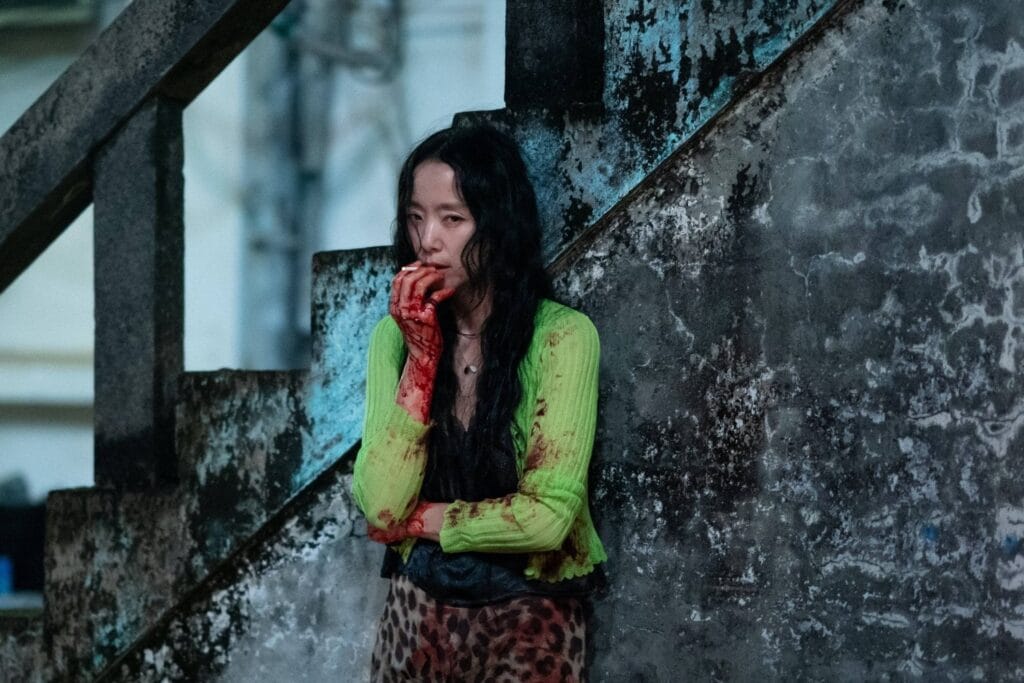
The narrative structure is built on a pact with the devil, but in this story, the devil wears a prison uniform. The opening sequence is a masterclass in contrast: it cuts sharply from the pristine whiteness of a wedding to the visceral red of a crime scene. We are introduced to Ahn Yun-su (Jeon Do-yeon), a free-spirited art teacher whose quiet life is shattered when her husband is found brutally murdered in his studio.
The visual storytelling here is crucial: teasers showed Yun-su cradling her bloodied husband, making a frantic emergency call, yet her composure during the police interrogation is unsettling enough to turn the public against her. Despite her desperate pleas, the legal system—eager for a quick resolution—brands her a “crazy woman” and sentences her to life in prison.
Her world effectively ends until she meets Mo-eun (Kim Go-eun). Known as a “witch” among the inmates and an admitted serial killer, Mo-eun is an enigma. She is the only one who doesn’t look at Yun-su with pity or contempt, but with recognition. She offers Yun-su a terrifying proposition: she will confess to killing Yun-su’s husband, providing the “new evidence” needed to secure Yun-su’s release. In return, once free, Yun-su must do one thing: kill a man for her.
Themes: Beyond Good and Evil
1. The Illusion of Accountability
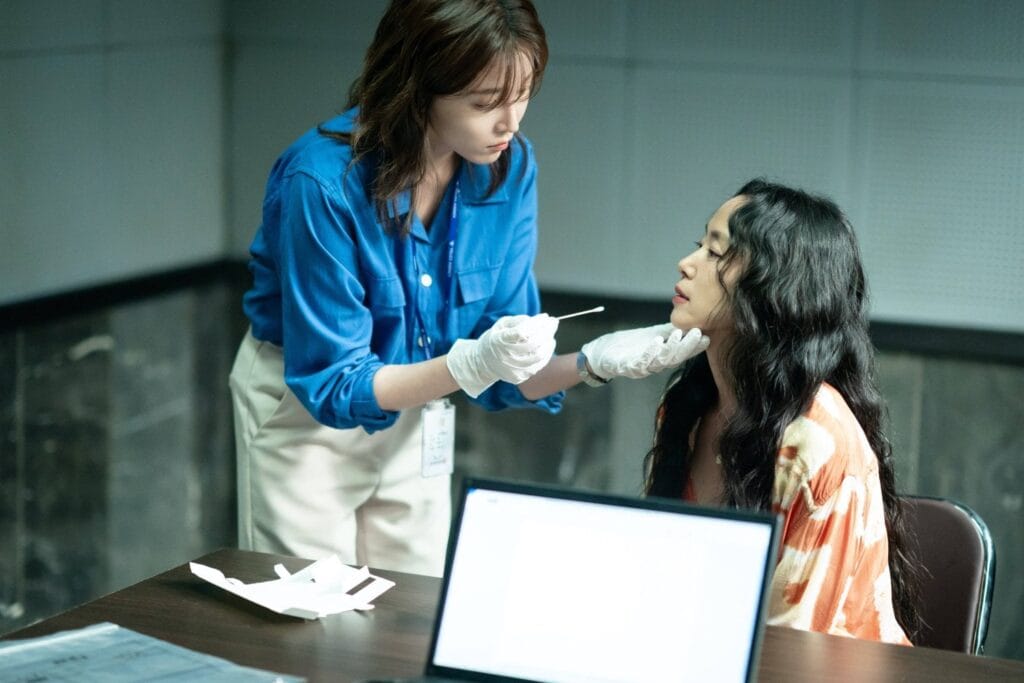
Perhaps the most frustrating—and arguably realistic—aspect of The Price of Confession is its portrayal of the justice system. The drama posits that the system is less concerned with “truth” than it is with “wins.” This is personified in Prosecutor Baek Dong-hun (Park Hae-soo), who plays a major role in destroying Yun-su’s life.
Baek operates with dangerous tunnel vision and confirmation bias. He represents the “corruption of incompetence”—he isn’t necessarily taking bribes, but his arrogance blinds him to the actual evidence. He allows the true villains to run free while remaining obsessed with framing an innocent woman simply because she doesn’t fit his model of a “grieving widow.” The show refuses to give the audience the easy catharsis of seeing him punished; instead, he walks away with a bruised ego but his career intact, a sobering reminder of how power protects its own.
2. Digital Cruelty and the “Invisible” Crime
A subplot that gives the drama unexpected modern relevance is its exploration of deepfake trafficking. The series highlights how digital cruelty operates: it is invisible to the outside world until it detonates in a victim’s real life, causing irreversible damage.
The narrative refuses to let the victims of this digital violence be mere footnotes. Through Yun-su’s journey, the audience is forced to sit with the weight of this violation—how a person’s identity can be stolen, twisted, and sold without them ever being physically touched. It paints a terrifying picture of a world where technology has outpaced morality, and where the law is woefully ill-equipped to protect women from virtual exploitation.
3. Confession as Currency
The title The Price of Confession (Jabaegui Daega) is literal. In this world, a confession is not an admission of guilt; it is a transaction. Mo-eun uses her “confession” as currency to buy Yun-su’s agency. Yun-su, in turn, must pay for that freedom with her own soul. The show asks a chilling question: if the truth can set you free, what is the cost of a lie that saves your life?
Character Analysis: A Duel of Acting Titans
- Ahn Yun-su (Jeon Do-yeon):Jeon Do-yeon delivers a performance that feels dangerously fragile. She portrays Yun-su not as a stoic heroine, but as a woman unraveling. She captures the “eccentric” energy of an art teacher who has never had to be tough, making her transformation into a survivor all the more painful. She nails the specific tragedy of a woman who is punished for being “emotional” and “weird” rather than for actually being guilty.
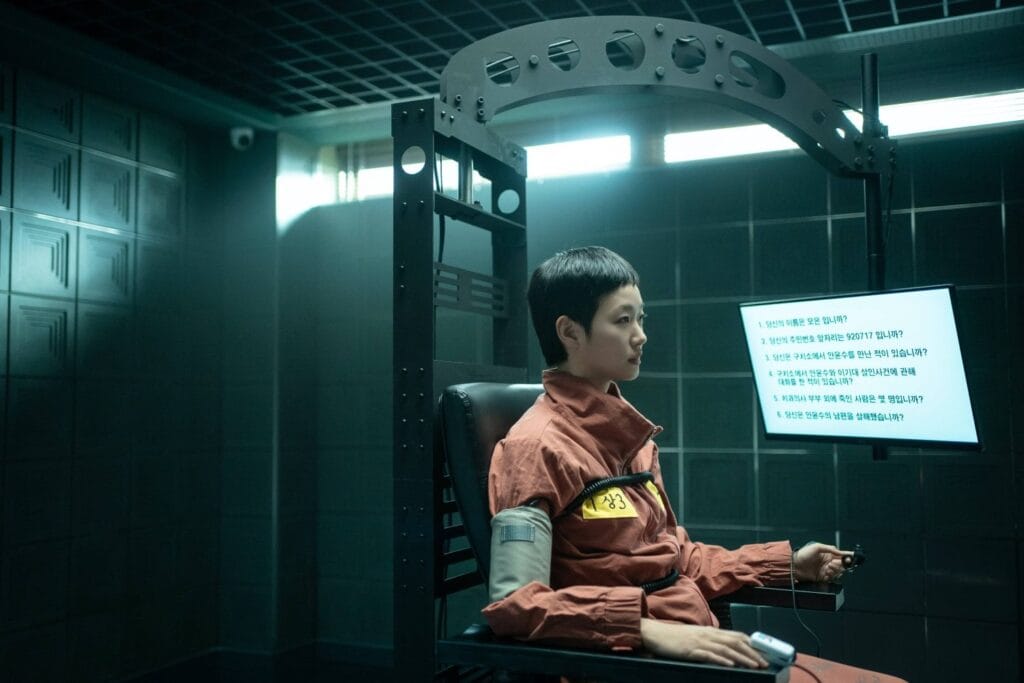
- Mo-eun (Kim Go-eun):If Yun-su is the heart, Mo-eun is the knife. Kim Go-eun sheds her usual bubbly image for a role defined by dead eyes and a jagged, short haircut. She is terrifyingly self-possessed, reading people’s desires with sociopathic precision. Yet, Kim imbues the character with a strange, twisted empathy. We believe her as a cold-blooded killer, but we also believe her as a grieving sister who burned down the world because it hurt someone she loved. Her chemistry with Jeon is electric; they circle each other in a dance of fear and need that anchors the entire show.

Key Lines and Taglines
The dialogue in The Price of Confession is sparse but razor-sharp, often doubling as thematic taglines for the series.
- The Proposition: “I will confess that I killed your husband. That is my offer.” – Mo-eun
- The Tagline: “Suspicious innocence, traded confessions.” – Official Poster Text
- The Prosecutor’s Philosophy: “Suspicious innocence is worse than proven guilt.” – Prosecutor Baek (Summarizing his bias).
- The Prison Bond: “Fighting, unnie!” – Mo-eun (A line delivered with chilling cheerfulness as Yun-su descends into moral corruption).
- The Reality: “The price of confession… everyone pays it eventually.” – Mo-eun
- The Farewell: “Go. Live the life I couldn’t.” – Mo-eun (Episode 12).
Cinematography and Visuals
Director Lee Jung-hyo (Crash Landing on You) creates a suffocating atmosphere that mirrors the characters’ internal states. The visual language is defined by barriers.
- The Wall: One of the most striking images from the promotional campaign—and the show itself—features the two women in matching prison uniforms, separated by a concrete wall but reaching toward each other. This visual metaphor perfectly encapsulates their relationship: they are connected by their shared isolation, yet separated by their different morals.
- The Color Palette: The prison scenes are shot in desaturated, sterile blues and greys, making the sudden bursts of violence (blood) or emotion (tears) pop with startling intensity. In contrast, the flashbacks to Yun-su’s life before the murder are warm but slightly out-of-focus, suggesting a reality that is slipping away.
Impact and Reception
If we apply the logic that the simplest explanation is usually the correct one, the success of this show isn’t found in the writer’s room, but in the casting. It is a 9/10 drama for acting, but a 6/10 for writing.
- The “Nose Dive”: The first half of the drama is gripping, maintaining the mystery of “Who really killed the husband?” well past the midway mark. However, the plot stumbles in the second half. The writers seem determined to end every episode on a cliffhanger, relying on repetitive kidnappings, jailbreaks, and misdirection that eventually lose their impact.
- The Binge Model: Netflix’s decision to drop all episodes at once arguably did the series a disservice. This is a complex, heavy narrative that begs to be digested slowly. Instead, the binge model meant that social media was flooded with spoilers about the ending within hours, ruining the suspense for many viewers.
- The “Womance” Factor: Despite the plot holes, the “womance” (woman-romance) between Jeon and Kim became an instant cultural phenomenon, with fans praising their chemistry as the most compelling love story of the year, platonic or otherwise.
The Price of Confession Special Episode: Episode 12 (The Finale)
Title: “The Final Payment” 🩸
The finale is a mixed bag that leaves the audience torn between satisfaction and rage.
The Twist That Failed to Land 🎭
The ultimate reveal—that the defense lawyer was the mastermind behind the killings—felt like a letdown for many. Because the narrative hadn’t invested enough time in his character, the twist felt “pantomime” rather than earned. The grandfather’s revenge arc also contributed to a cluttered final act that lacked the razor-sharp focus of the earlier episodes.
Mo-eun’s Sacrifice 🕊️
However, the emotional resolution for the two leads redeems the messy plot. Mo-eun’s decision to kill the true villain and then end her own life feels like the only honest conclusion for her character. She was a woman who had already destroyed herself to survive; her death wasn’t a defeat, but a final act of agency. It was a “payment” she chose to make to ensure Yun-su could walk free.
The “Thai” Ending 🇹🇭
The epilogue sees Yun-su starting a quiet, anonymous life in Thailand. It’s a somber, beautiful note to end on. It acknowledges that trauma doesn’t just disappear with a “Not Guilty” verdict. Yun-su is free, but she carries the ghost of Mo-eun with her. It is a reminder that stories are constantly rewritten, and sometimes, the happy ending isn’t about everything being fixed, but about simply surviving to see another day.
Conclusion
“The Price of Confession” is a flawed masterpiece. It is messy, frustrating, and at times repetitive, but it is also undeniably powerful. It demands you look at the cracks in the justice system and the lengths women will go to when backed into a corner.
Verdict: Watch it for the acting. Stay for the chemistry. But be prepared to scream at the screen when the prosecutor walks away scot-free.




Leave a Comment